
EGCP Landbird Plan
Oct-2021 with Appendices
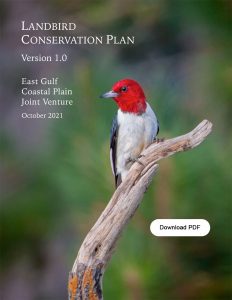
Conservation Plan v1.0
EGCP Landbird Plan
Oct-2021
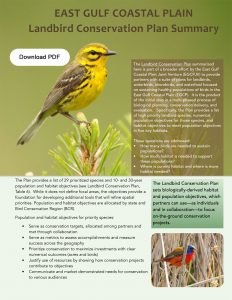
Summary V1.1
East Gulf Coastal Plain Joint Venture Conservation Planning
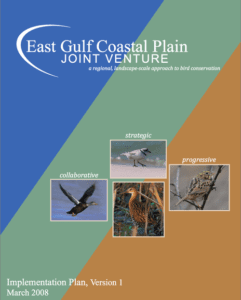
East Gulf Coastal Plain Joint Venture Implementation Plan lays out how to achieve the long‐term objective of the partnership, which is to ensure the sustainability of priority bird populations, and the habitats and ecological communities of which they are an integral part.
Bird Conservation Initiative Plans
Five major bird initiatives guide the Joint Ventures in helping to achieve bird conservation at continental scales by providing the foundation for bird conservation across North America:

Partners in Flight (PIF), 1990
Goal
Improve monitoring and inventory, research, management, and educational programs concerning land birds (including songbirds) of the U.S. and their habitats.
- Executive Summary (not available at this time)
- Part One (not available at this time)
- Part Two (not available at this time)
- Literature Cited and Appendices (not available at this time)

National Bobwhite Conservation Initiative (NBCI), 2002
Goal
This first-ever large-scale, coordinated and collaborative plan was created by the Southeast Association of Fish & Wildlife Agencies to reverse the serious decline of bobwhite populations across most of its range. The goal is to restore northern bobwhite populations range wide (across the Southeastern U.S.) to an average density equivalent to that which existed in 1980.
The North American Waterfowl Management Plan (NAWMP), 1986

Goal
Restore habitat sufficient to support waterfowl at desired levels throughout the United States, Canada and Mexico. The original plan was updated in 1994, 1998 and 2004.
- 2012 North American Waterfowl Management Plan
- 2018 North American Waterfowl Management Plan
- 2012 NAWMP Action Plan
- 2012 Revised Objectives
- Previous Plan Revisions

United States Shorebird Conservation Plan (USSCP)
Goal
Set and achieve conservation goals, identify critical habitat needs, and increase awareness of shorebirds and the threats they face throughout the U.S. and Caribbean.
North American Waterbird Conservation Plan (NAWCP), 1998
Goal
Sustain or restore the distribution, diversity, and abundance of waterbirds (not already covered by the waterfowl and shorebird conservation plans) and their habitats throughout the United States, Caribbean, Mexico and Central America.
